
Robert Taylor
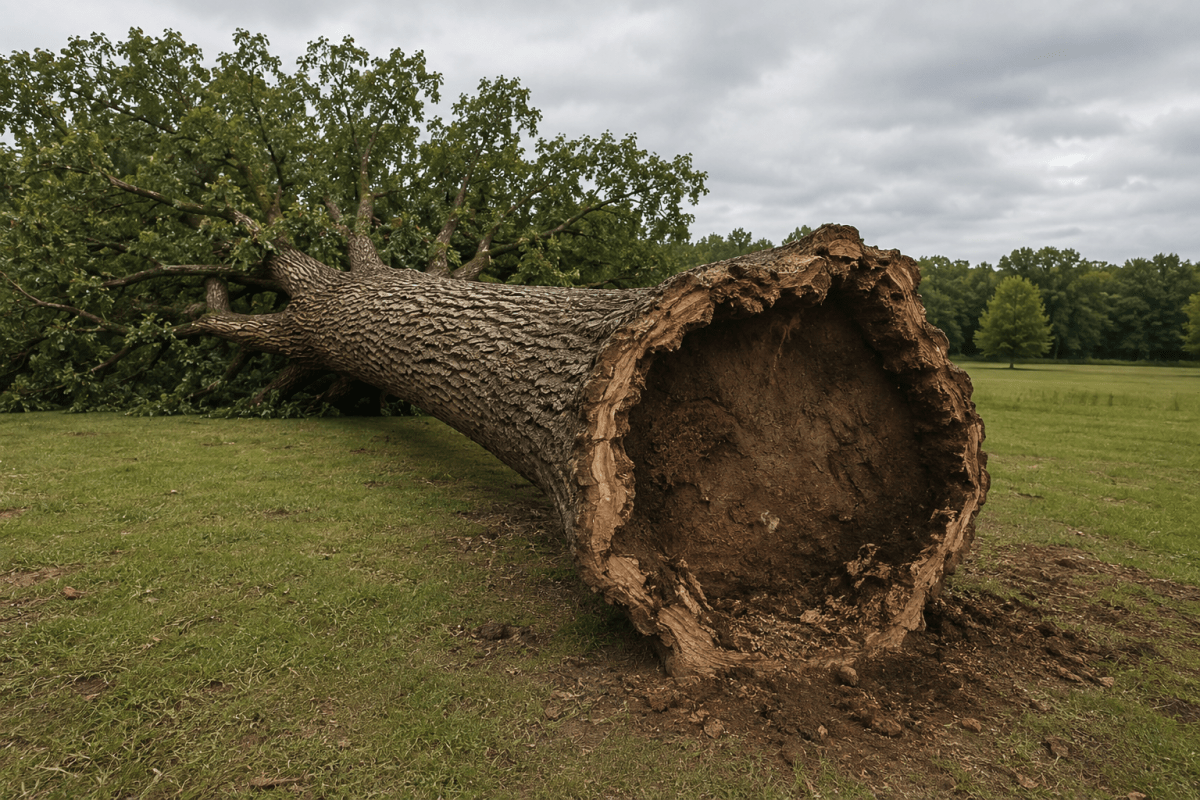
“You mean that big tree fell on top of that house?” That was my reaction to the news.
My wife and I were at a sandwich shop having dinner when our neighbor texted us about the tree down the block.
That tree was the oldest in our town, or so the city arborist claimed. A Goliath, over a hundred feet. For years it had stood like a sentinel at the entrance to a house where a family with small children lived.
Regal, right up until one night.
No storm. Just a small gust, a crack, and it lay across the roof—split down the middle, the way you’d cleave a piece of meat. The house was crushed underneath it.
The family got out safe, though they had to climb through a broken window to do it.
Come daylight, you could see the problem from the street. No deep roots. The tree hadn’t been knocked down by anything violent — it had simply given way, the way things do.
And it struck me: the size of a tree tells you nothing about the size of its roots.
We forget the roots exist at all, honestly, because all we ever look at are the limbs and the leaves. But the roots are where the life is. The roots hold everything up.
I’ve watched people spend a lifetime polishing the outside of their lives while the inside goes untended. When I was young, we had a preacher — full of energy, full of drive — who let his inner life drift, and before long he was “visiting” a woman who’d just gone through a divorce. What started quiet didn’t stay quiet.
My father, not even forty at the time, was one of the men who had to confront him. I remember the look on my dad’s face. Shock. Disgust.
That preacher lost everything. His wife left and took their daughter. The church let him go. Last I knew he was selling used cars.
I still think about it sometimes — how his public self turned out to be nothing but a performance. I’ve never quite looked at people the same way since. I find myself wondering what’s underneath the polish.
Doesn’t matter how tall the tree is if the roots have rotted out.
When Jesus went looking for a word to describe this kind of person, he reached into the vocabulary of the theater — hypocrite. An actor. Someone who puts on a mask and plays whatever part the scene calls for. Someone who is, in other words, not who he appears to be.
Solomon draws the same contrast in Proverbs 28:6 — the rich man everyone admires but who’s crooked underneath, against the poor man nobody notices who actually has integrity. And that word integrity is worth sitting with. It means you have nothing to cover up. Nothing to hide.
Playing a role is a dangerous game. It’s wrecked careers. It’s wrecked marriages. It’s wrecked reputations. What you are always outweighs what you look like.
None of us likes to think we’re capable of this kind of hypocrisy. But we fool ourselves more easily than we’d like to admit.
So take a hard look at yourself. Be honest about it — warts and all. An inflated self-image isn’t worth much. It has no roots holding it up.
And pay attention when other people criticize you, especially the ones who don’t like you much. Does it sting more than it should? That might be a crack you’d rather not look at. That might be rot in the roots.
Sooner or later, if you don’t deal with what’s underneath, the image you’ve built comes down.
What happens to that house down our street, I don’t know yet. Right now it’s just a sad reminder of what happens when the roots give out.
Let’s make sure that’s never said of us.
Discover more from Catalyst
Subscribe to get the latest posts sent to your email.
Editor's Pick

Discover more from Catalyst
Subscribe to get the latest posts sent to your email.

Discover more from Catalyst
Subscribe to get the latest posts sent to your email.

Discover more from Catalyst
Subscribe to get the latest posts sent to your email.
Leave A Comment
Related Posts
Discover more from Catalyst
Subscribe to get the latest posts sent to your email.
Discover more from Catalyst
Subscribe to get the latest posts sent to your email.
Discover more from Catalyst
Subscribe to get the latest posts sent to your email.
Discover more from Catalyst
Subscribe to get the latest posts sent to your email.